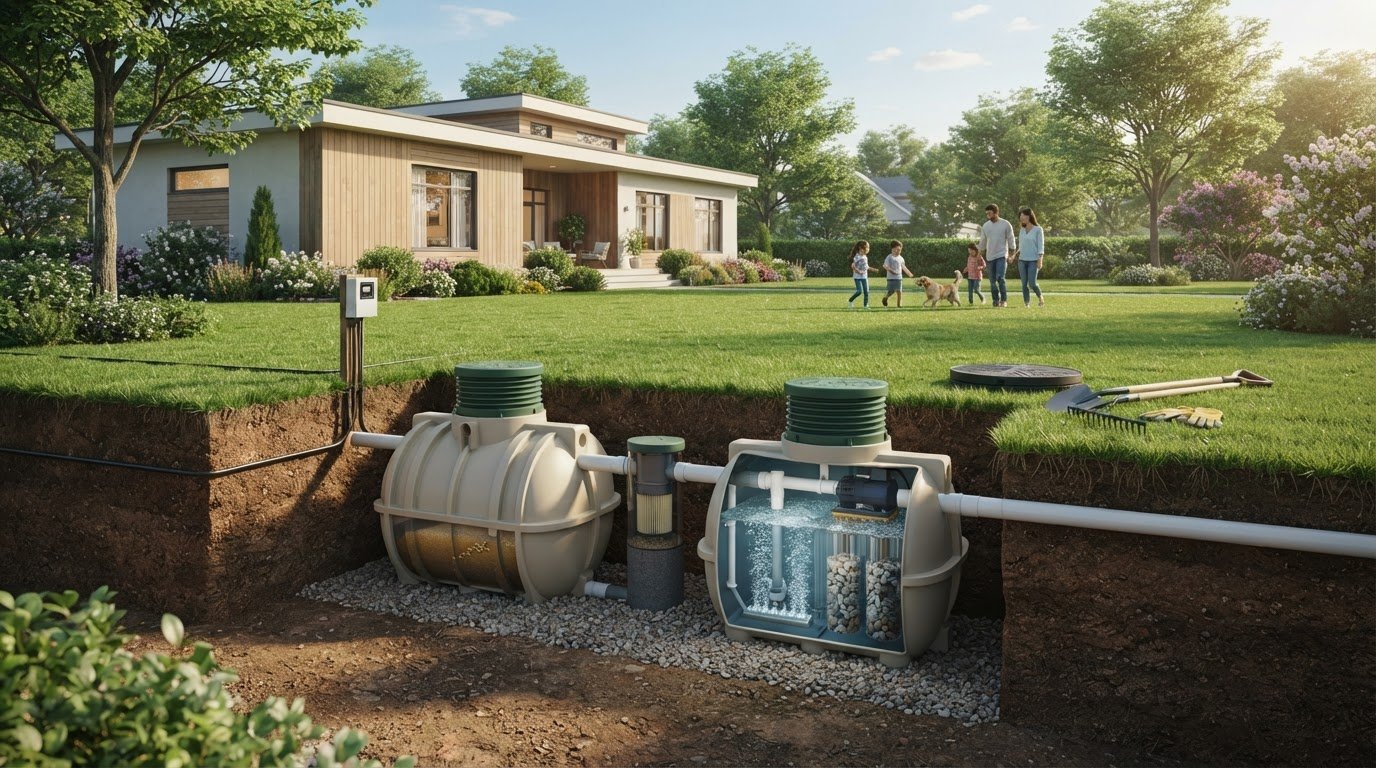

The Eco-Nest septic system review points to reported removal of more than 90% of BOD and more than 93% of TSS. Those results offer a useful measure of treatment performance, but they don’t tell you the full ownership picture. Installation equipment, ongoing electricity use, service needs, and filter care also affect whether the system suits your property.
That trade-off matters when you’re comparing septic options. Treatment results are only one part of the decision: consider the work involved in operating and maintaining the system, too. A clear comparison helps you weigh these factors without treating one performance figure as the whole answer.
This guide examines installation and electrical hookups, customer support, 25-year operating-cost factors, treatment performance, and filter-media care. You’ll learn which system details to consider, how scheduled upkeep fits into ownership, and what to compare before deciding whether Eco-Nest is appropriate for your needs.
Key Takeaways
- Compare the system’s equipment and electrical requirements with your property’s setup before weighing installation decisions.
- Map out early service visits and routine maintenance so you can plan for care beyond installation.
- Build a 25-year cost comparison around operating needs and replacement intervals, not just the initial system choice.
- Use treatment performance data to understand how the system handles organic matter and suspended solids.
- Know when the effluent filter needs inspection and how local requirements affect its upkeep.
Installation equipment and electrical hookups
Eco-Nest is available for flows from 450 to 1,500 gallons per day, with one-, two-, and three-tank configurations. Soil and climate suitability depends on site design; property sizing starts with wastewater flow and the system configuration.
For installation planning, consider the tank layout, compressor hookup, and control equipment separately. Each affects component placement and how the system operates.
Compressor and Electrical Requirements
The Eco-Nest compressor plugs into a standard 115-volt outlet and supplies air for treatment. Its control panel and alarm use self-contained batteries. On gravity-flow systems, this setup removes the need to hire an electrician for those controls. Unlike a system relying on powered controls, the battery-powered panel and alarm keep those functions separate from the compressor’s outlet connection.
Before setup, identify an accessible outlet for the compressor and locations for the panel and alarm. Eco-Nest systems are designed to fit locally available precast septic tanks without special configurations. This can simplify tank coordination, but the configuration still needs to suit the site design and flow requirements.
Electricity Use
The compressor operates continuously, so plan for ongoing electricity use rather than occasional cycling. An outlet nearby is required, and the system remains connected during normal occupancy. The air pump runs continuously 24/7, making its power connection an essential part of ongoing operation rather than an occasional task. One customer reported 24-hour operation throughout the year without noticing a change in the electric bill. That experience is an individual report, not a guaranteed estimate for your household. Your actual use depends on continuous operation and your electricity rate.
If the property will be vacant for 90 days or more, owners are advised to turn off compressor power. During winter, turn it off when the property will be vacant for more than two weeks. Follow those operating instructions when planning seasonal use.
Compare these configuration details before choosing:
| Option | Flow range | Tank configuration | Electrical setup |
|---|---|---|---|
| Eco-Nest system | 450 to 1,500 gallons per day | One, two, or three tanks | 115-volt compressor; battery-powered control panel and alarm |
| Eco-Nest AS450-2 | 450-gallon-per-day flow class | Two tanks | Same compressor and control arrangement |
| Eco-Nest AS600-2 | 600-gallon-per-day flow class | Two tanks | Same compressor and control arrangement |
The AS450-2 has a nominal chamber volume of 1,000 gallons, while the AS600-2 has 1,340 gallons. Choose by matching the required flow and tank configuration to the site design, not by chamber volume alone.
During setup, connect the compressor to its outlet and ensure the airline reaches the treatment equipment. If you are troubleshooting low airflow, check whether airline pressure is within the three-to-five-psi range. This helps focus troubleshooting on air delivery rather than assuming the tank configuration is the cause. Position the control panel and alarm where they are accessible, and follow the operating instructions during vacant periods.
For seasonal planning, guidance says to turn off the compressor power when the property will be vacant for more than two weeks during winter. This keeps the seasonal shutdown instruction distinct from routine continuous operation.
Customer service and technical support
Eco-Nest is described as NSF/ANSI Standard 40, Class I certified. That certification concerns treatment performance; it does not, by itself, define warranty coverage or support terms. For warranty questions, read the written warranty for coverage, exclusions, and claim steps. Keep it with system records so you can refer to the applicable terms when a concern arises.
The initial service policy calls for an inspection or service visit every six months during the first two years of operation, for four visits in total. Use each visit to discuss system condition, observations around the property, and any change in performance. Request a written record of findings and recommended follow-up, and keep it with the installation documents.
For post-installation concerns, timing matters. Report persistent septic odor if it remains two to five days after installation. Describe where it occurs, when it began, and whether it changes with household activity. These details give support personnel a clearer starting point for troubleshooting than a general report of an unpleasant smell.
Emergency service for an Eco-Nest system should be available within 48 hours of a service request if required. When requesting help, state whether the issue is an alarm, odor, or another observable change. Include when it started and what you have already noticed. A clear description helps distinguish an urgent concern from an item to discuss at the next scheduled visit.
- Record the issue: Note the symptom, its start date, and any change over time.
- Share relevant records: Keep service notes and warranty documents together.
- Report persistent odor: Contact support if it remains after two to five days following installation.
- Request urgent service: Describe the problem clearly when emergency attention is required.
Support is most useful when you can provide an accurate history. A dated note showing that an odor continued beyond the post-installation reporting period, for example, is more actionable than an undated complaint. Keep copies of visit records, written recommendations, and correspondence. These documents also help you understand how the warranty terms apply to the reported issue.
Use the system’s technical support information alongside your service records and written warranty. A certification, scheduled visit, and warranty each answer different questions. Keeping those distinctions clear helps you prepare focused questions and make the next support conversation more productive.
When following up on an odor concern, keep the report focused on what you directly observe. State whether the septic odor is still present after 2-5 days following Eco-Nest system installation, and note where and when it is noticeable. If its pattern changes, include that observation without guessing at a cause. Keep the account consistent with your service notes so the concern can be considered alongside earlier observations.
If you’re unsure whether an odor warrants a call, use the reporting threshold rather than waiting to diagnose the cause. Give a concise, consistent description when contacting support and documenting the concern. This gives the conversation a concrete starting point and helps you track changes.

Septic system operating costs over 25 years
A 25-year comparison should include routine maintenance, electricity, and component replacement, not just the system’s initial setup. The schedule of care can shape the long-term total.
Eco-Nest Versus Conventional Septic Systems
Eco-Nest uses an electric air pump and aerobic treatment, while conventional systems rely on different treatment steps. Compare operating costs by listing pumping, power, maintenance, and replacement needs for each system over the same period. Eco-Nest compressor refurbishment typically occurs after two to five years. Conventional septic tanks normally require pump-outs every three to five years, alongside advanced system maintenance.
For Eco-Nest, include alarm batteries every six months and compressor refurbishment in your cost worksheet. Tank pump-outs are normally required every three to five years, in addition to advanced septic system maintenance. Pump all chambers at least once every three years, or sooner if sludge and scum together exceed 30% of tank volume.
If either system requires an effluent pump, allow for replacement every seven years on average. Build your 25-year comparison by recording each maintenance interval and component, then applying the relevant local service and replacement costs. This makes recurring costs visible without treating a single customer’s experience as a dependable estimate for every property.
Eco-Nest is an aerobic treatment unit that uses an air pump and Bio-Brush media to support attached-growth bacteria. Wastewater is treated as it moves through the system, rather than relying only on a conventional septic tank and soil absorption process.
For permits, requirements depend on the state and local rules governing the site. System designs must comply with applicable state administrative codes, plus relevant local policies and ordinances. Many jurisdictions have approved Eco-Nest NSF/ANSI Standard 40 aerobic treatment units for new, replacement, and repair installations.
Owner reports describe varied experiences, including a six-year customer account and reported changes in odor or surface water. These are individual examples, not a single customer rating or a guarantee of results. Potential advantages include aerobic treatment and available tank configurations; ongoing electricity use, service visits, and component upkeep are also considerations.
Eco-Nest Versus Other Alternatives
Alternatives may use different treatment equipment and maintenance schedules, so compare like with like. For each option, record required pumping, electricity use, service visits, and parts replacement. Eco-Nest’s cost profile includes a continuously operating compressor and scheduled component care, unlike systems without an air pump.
Reported concerns include persistent odor after installation, low airflow, and alarm conditions. Report persistent odor if it remains two to five days after installation. For low airflow, check airline pressure against the three-to-five-psi range. These are troubleshooting points, not proof that every system will experience a failure.
No single lifespan figure applies to every system. The tank’s condition, compressor upkeep, and maintenance history all affect service life. For a sound 25-year projection, track actual component work and routine care rather than assuming the tank, compressor, and other parts share one replacement date.
BOD and TSS removal
Biochemical oxygen demand (BOD) and total suspended solids (TSS) measure different aspects of wastewater quality. BOD reflects oxygen used as organic material breaks down; TSS measures suspended particles remaining in water. Eco-Nest aerobic treatment is reported to achieve more than 90% BOD removal and more than 93% TSS removal. A useful Eco-Nest septic system review considers both measures separately.
The process combines extended aeration with attached-growth bacteria on Bio-Brush media. Aeration supplies oxygen, and the media provides surface area for aerobic bacteria to grow and treat wastewater. Biological treatment reduces organic material, while the system also supports the separation of suspended particles. The two removal figures describe separate measurements, not one combined efficiency score.
Compare those reported results with the treatment criteria that apply to your project. Under the BNQ NQ 3680 910 Class III standard, the 30-day average CBOD5 limit is 15 mg/L or less. The same standard sets a 30-day average TSS limit of 15 mg/L or less. CBOD5 is a carbonaceous oxygen-demand measure, related to but distinct from BOD.
| Measure | What it indicates | Reported treatment result or criterion |
|---|---|---|
| BOD | Oxygen demand from biodegradable organic material | More than 90% removal reported |
| TSS | Suspended particles in wastewater | More than 93% removal reported |
| CBOD5 | Carbonaceous oxygen demand over five days | BNQ Class III: 15 mg/L or less, 30-day average |
| TSS concentration | Solids concentration in treated effluent | BNQ Class III: 15 mg/L or less, 30-day average |
Use the table as a comparison aid, not as proof that every installation produces identical effluent. Removal percentages compare influent and effluent, while concentration limits set an effluent threshold. Check the test method and operating conditions behind each performance figure. Be cautious of products promoted without certified test data: broad claims are difficult to assess without documented results.
For a more useful Eco-Nest septic system review, connect the treatment figures to system design and operation. Flow, tank configuration, aeration, and biological growth all affect treatment. If a report gives one result, identify whether it measures BOD, CBOD5, or TSS. Also distinguish removal percentage from effluent concentration. Those details make performance comparisons clearer and help you assess whether reported results fit your project’s treatment criteria.
Filter media lifespan and renewal
Filter care follows a specific inspection schedule, while media renewal depends on the component’s condition. If local or state code requires an Effluent Filter, check it six months after installation and annually thereafter. This sets when to inspect, not a universal replacement date for filter media.
Keep the filter and treatment media distinct in your maintenance records. An Effluent Filter sits at the tank outlet, blocking solids while allowing liquids to pass. Bio-Brush media is part of the treatment system. An observation about the outlet filter alone doesn’t establish that treatment media needs renewal, so record each finding under the correct component.
At each required filter inspection, note the date, visible solids, and any action taken. Use the same record format each time to make changes easier to compare and maintain a clear history if the filter’s condition changes. Follow the system’s maintenance instructions for handling and cleaning; don’t infer a renewal interval from a single observation.
Filter media doesn’t have one automatic replacement date. The inspection schedule tells you when to assess a code-required Effluent Filter, while your observations document its condition. Keep the inspection date and findings together. If the record shows a change, refer to the system’s maintenance instructions and document the next action rather than assuming every component needs replacement.
A practical Eco-Nest septic system review should distinguish filter inspections from media-renewal decisions. Track these details:
- Inspection timing: Record the six-month check and annual checks thereafter when the Effluent Filter is required by local or state code.
- Component: Identify whether the observation concerns the outlet filter or Bio-Brush media.
- Condition: Note visible solids or other relevant observations without treating them as a replacement diagnosis.
- Action: Document any cleaning, service, or follow-up guided by the system’s maintenance instructions.
This record helps distinguish a filter finding from a broader question about treatment media. Compare notes over time, and don’t treat the filter inspection schedule as a media lifespan guarantee. An Eco-Nest septic system review is more useful when you inspect the filter on its required schedule and base renewal decisions on the relevant component’s condition and maintenance guidance.
Aero-Stream: Eco-Nest™ NSF/ANSI 40 Systems
Aero-Stream offers Eco-Nest™ NSF/ANSI 40 Systems for property owners considering aerobic wastewater treatment. If your comparison points toward an aerobic treatment unit, review the system’s treatment results, electrical needs, service schedule, and filter requirements together. That gives you a practical basis for deciding whether its operating demands fit your property.
Eco-Nest systems use Bio-Brush® media to support attached-growth bacteria and come in configurations designed for different wastewater flows. Choose a system based on site requirements and the maintenance you can plan for, not treatment claims alone. If you’re weighing Eco-Nest against other options, Aero-Stream’s DIY-friendly systems and technical support can help you assess the fit for your needs.
Turn Your Research Into a Confident Next Step
Use this Eco-Nest septic system review to guide a practical decision for your property. Before choosing a system, write down your site priorities, the maintenance you’re prepared to manage, and any remaining questions about treatment and fit. A clear list makes the next conversation more useful.
Aero-Stream offers Eco-Nest™ NSF/ANSI 40 Systems, Residential Remediator® Kits, and Bio-Brush® media. Which option fits depends on whether you’re considering a new treatment system or addressing an existing septic system. Keep that distinction in view as you explore your choices, and focus on the specific outcome you need rather than features that don’t match your situation.
When you’re ready to discuss a suitable next step, contact Aero-Stream for septic support. Bring your site questions and priorities; a focused conversation can help you move forward with a clearer plan and greater confidence.
Frequently Asked Questions
What are the Eco-Nest septic system installation and ongoing maintenance costs?
Installation cost depends on the Eco-Nest™ model, site configuration, airline length, and any local permit or electrical work; Aero-Stream sells DIY-friendly kits but doesn’t provide on-site professional installation. Routine upkeep includes checking the Effluent Filter six months after installation, then annually, and cleaning it with a hose or replacing it as needed.
Eco-Nest septic system customer reviews and ratings
Owner reports describe varied experiences, including a six-year account and reported changes in odor or surface water. These individual accounts are examples, not a customer rating or a guarantee.
Is Eco-Nest suitable for different soil types, climates, and property sizes?
Suitability for soil and climate depends on site design. Property sizing starts with wastewater flow and system configuration; Eco-Nest is available for flows from 450 to 1,500 gallons per day in one-, two-, or three-tank configurations.